Magnitudes et Saisissement
Maison de la culture Frontenac, Montréal
Du 31 janvier au 5 mars 2006
Molior présente deux installations interactives à la Maison de la culture Frontenac: Magnitudes de François Quévillon et Saisissement de Clara Bonnes
Magnitudes de François Quévillon et Saisissement de Clara Bonnes, ont la particularité de faire valoir la tactilité au sein de l’expérience artistique. Magnitudes est une installation multisensorielle qui permet au visiteur de transformer la matière, tant sur le plan réel que virtuel, tout en évoquant des phénomènes naturels marqués par l’instabilité. Ce projet invite à considérer des forces naturelles non pas dans une attitude de conquête, mais de complicité au moyen d’une interaction à caractère ludique. Pour sa part, Saisissement propose aux visiteurs de prendre et de manipuler des objets munis de capteurs sensibles afin d’animer les images qu’ils présentent. Les vidéos qui résultent de l’interaction offrent des possibilités de parcours et de rencontres qui questionnent les rapports entre espaces intime et public.
Magnitudes et Saisissement à la Maison de la culture Frontenac /
Sylvie Parent
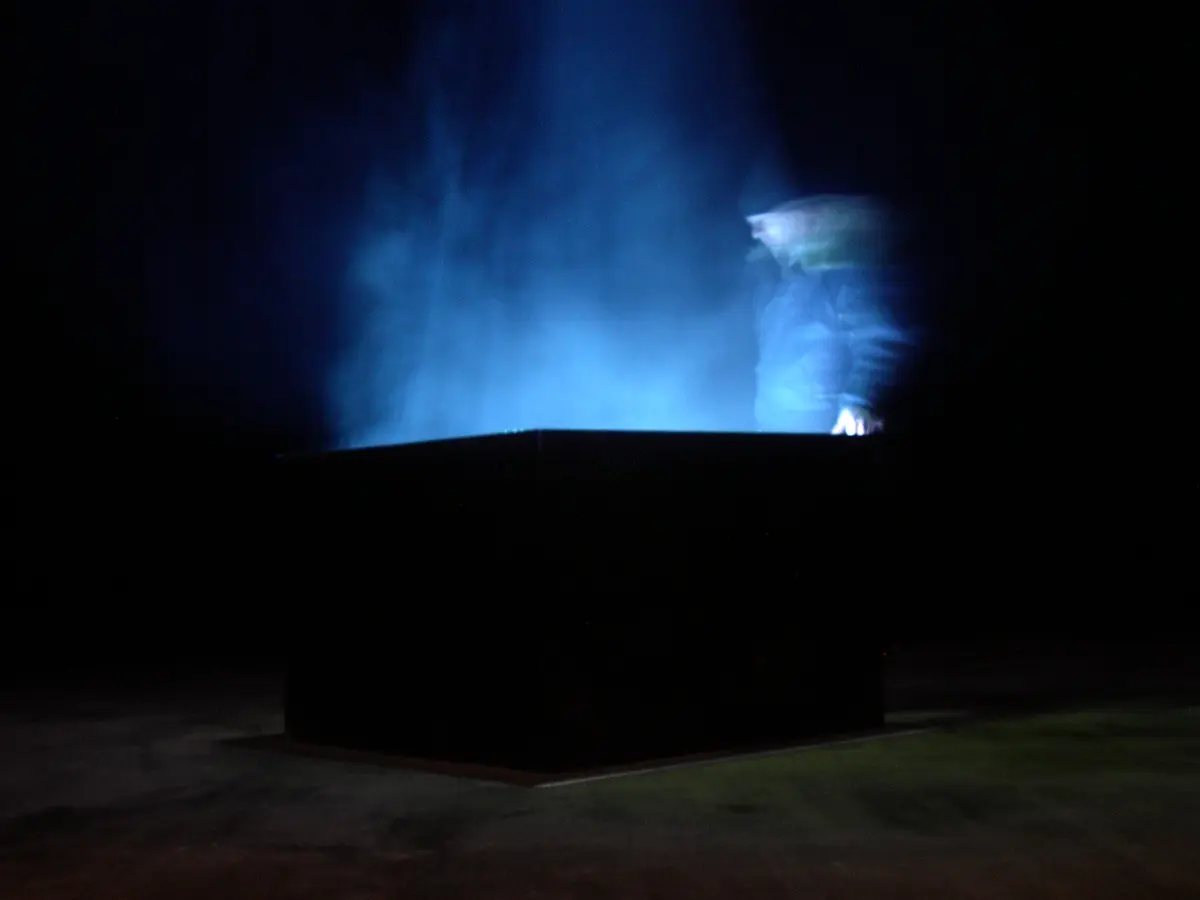
Avec Magnitudes, François Quévillon propose un environnement sonore, visuel et tactile que le visiteur transforme, d’abord par sa présence, puis par ses gestes. L’atmosphère sonore enveloppante qui l’accueille s’intensifie au fur et à mesure qu’il s’approche d’un objet cubique à la surface lumineuse. L’écran souple qui repose sur l’objet se met alors à vibrer et le son émis, tel un vrombissement, s’accroît toujours plus lorsqu’il surplombe l’objet ou en effleure la surface. Cette ambiance sonore s’accentue encore davantage lorsque plusieurs personnes participent à l’installation.
Par sa présence seule, le participant perturbe le silence et bouleverse la quiétude. Il a une résonance grandissante dans le lieu de l’installation. Déjà, avant même de considérer la surface de l’objet, de se pencher au-dessus d’elle et de la toucher, il prend connaissance d’un environnement réceptif à sa présence et à ses déplacements. Cette extension acoustique à son parcours lui procure une conscientisation de son corps dans l’espace, une certaine prise de conscience de soi. L’ambiance sonore qui découle de son déplacement l’invite à poursuivre son interaction avec l’objet en le confirmant comme sujet.
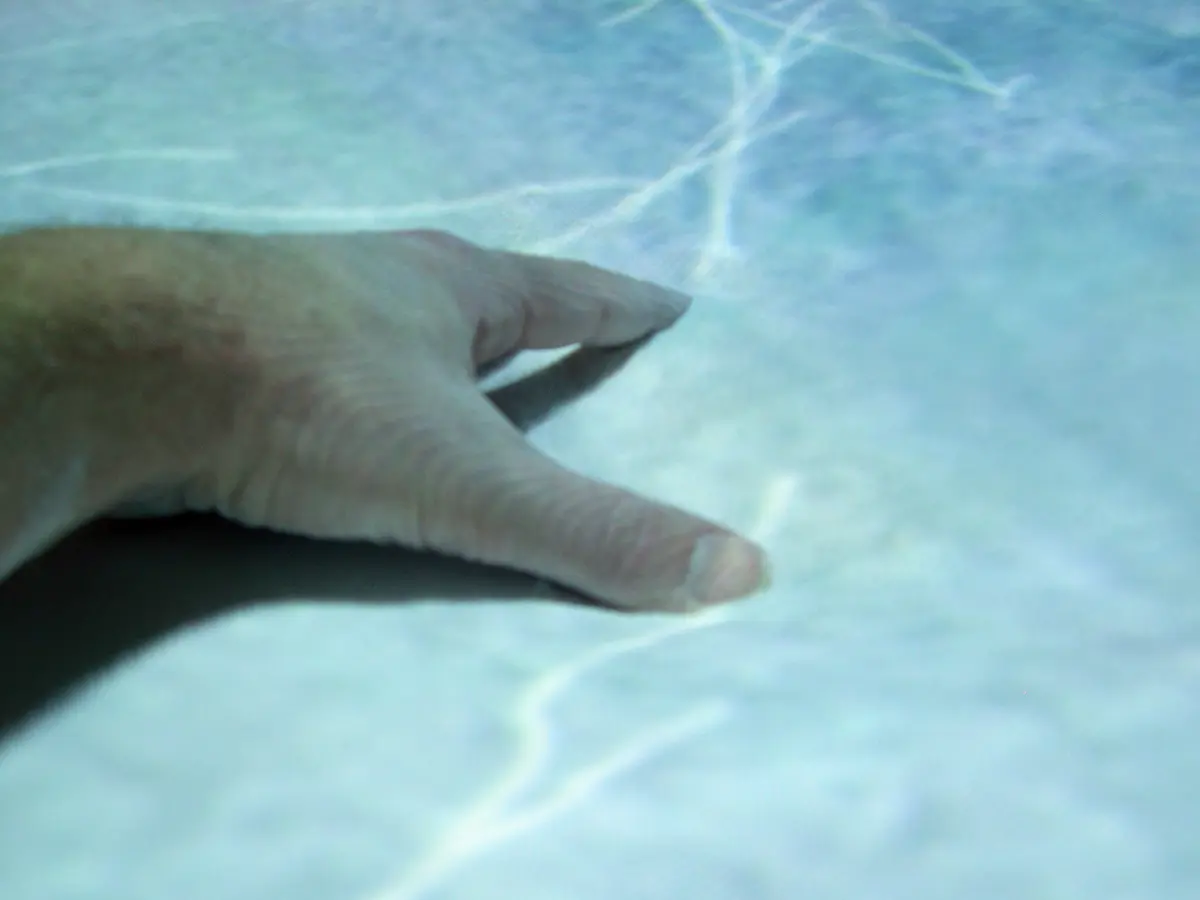
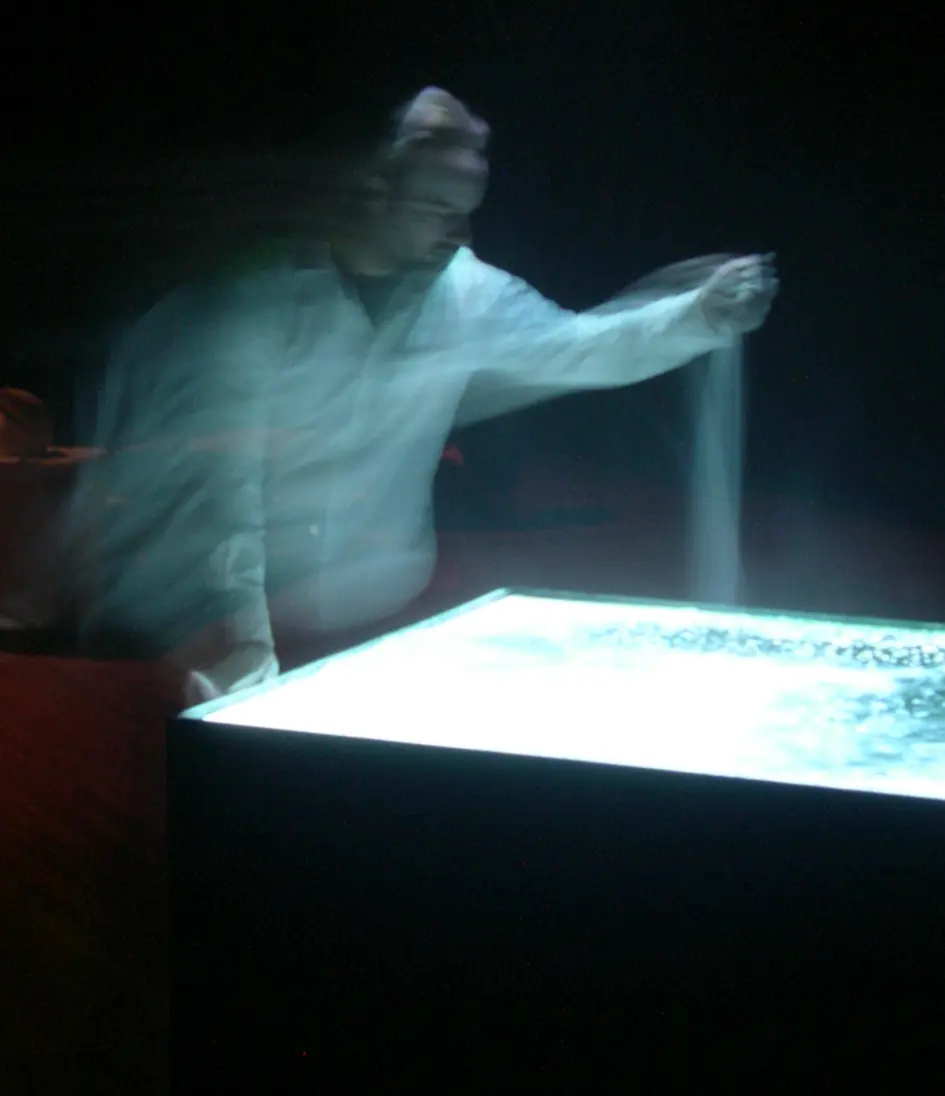
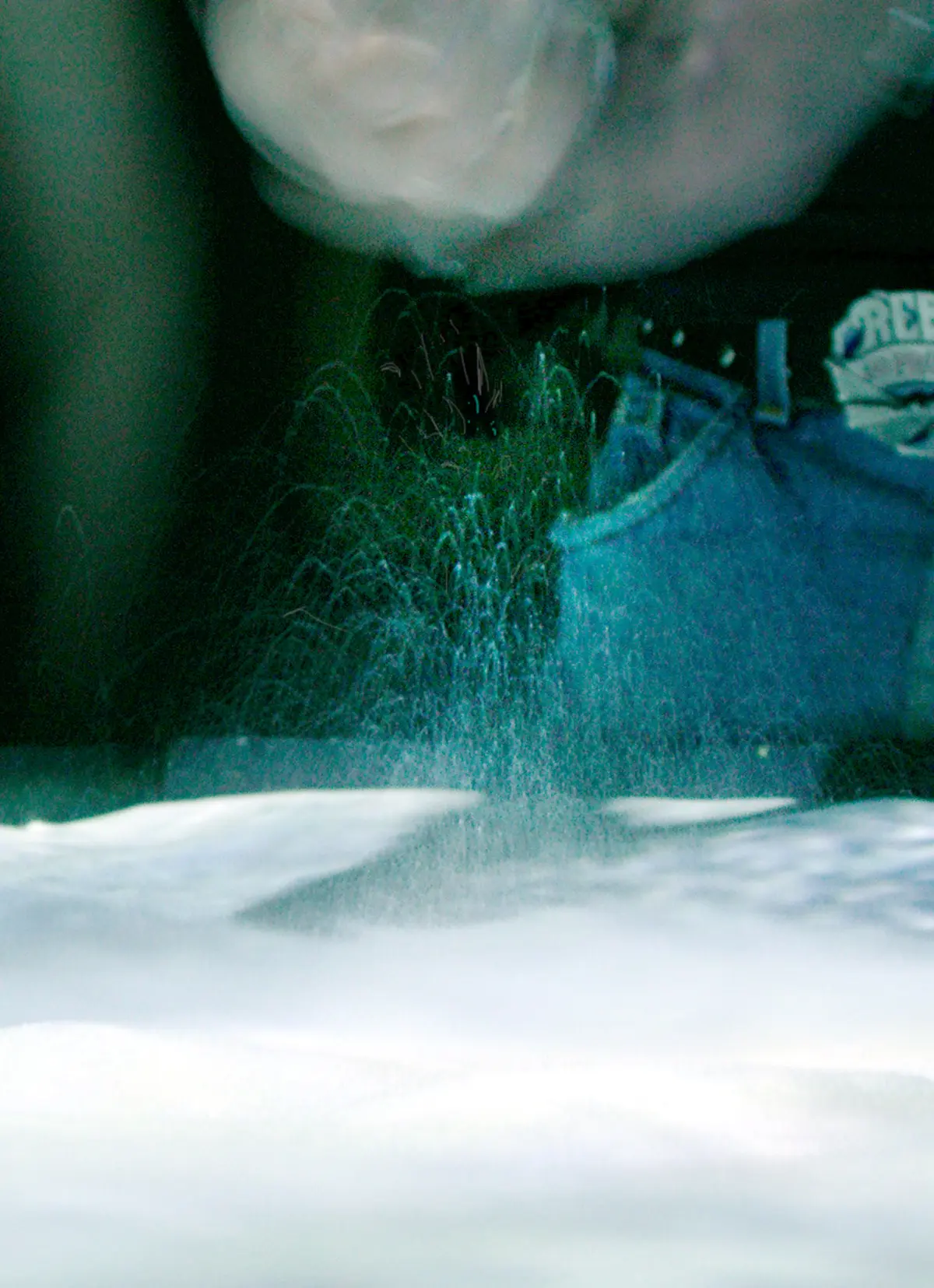
Montrant l’image vidéo d’une masse glacée qui fond lentement, la surface de l’objet est recouverte d’une fine couche de matière granuleuse blanche rappelant la neige. Lorsque le visiteur touche cette matière, le bruit augmente, faisant vibrer la surface couple de l’écran et sautiller les petits grains blancs au-dessus de lui. Par ailleurs, lorsqu’il bouge la main au-dessus de cet objet ou touche l’image, des fissures virtuelles correspondant à ses mouvements se dessinent sur la surface glacée, accompagnées de sons de craquements. Le participant passe ainsi à une intervention encore plus active, liée à sa gestualité et ayant une incidence directe on seulement sur l’environnement sonore, mais aussi sur la matière et l’image qui se trouvent devant lui.
Magnitudes utilise les références à l’hiver (glace, neige) pour plonger le spectateur dans un climat qui lui est familier mais qui contraste, par ailleurs, avec le lieu dans lequel est présentée l’installation. L’évocation du froid et de ses manifestations matérielles, dans un environnement à l’abri des fluctuations climatiques, contribue à créer une atmosphère singulière et envahissante, un espace fictif lié à l’imaginaire sensoriel. Mais ce n’est pas uniquement la mémoire des sensations qui est sollicitée. L’expérience bien tactile qui est proposée confronte cet imaginaire sensoriel d’une manière puissante et intime tout à la fois. Grâce à une matière véritable superposée à l’écran tactile, les comportements actuels alimentent les effets virtuels, les mêmes gestes ayant des effets distincts mais couplés, entremêlés, fusionnant la réalité et la fiction, la mémoire et l’actualisation, la sensorialité et l’intellectualisation.
Les particules blanches qui glissent entre les doigts, s’accumulent sous la poussée ou la pression rappellent le plaisir de manipuler la neige, de la voir prendre des formes diverses selon la volonté qui s’exerce sur elle. La main peut créer des sillons, des monticules, étaler la matière en une couche lisse. La surface devient comme une carte sur laquelle dessiner un plan en relief. Elle peut évoquer le paysage, les cartes géologiques, les images satellites. Les craquelures virtuelles, des lignes brisées qui apparaissent dans l’image de la glace en réaction aux parcours de la main au-dessus de l’écran, sont comme des itinéraires tout autant que des tracés aléatoires qui s’y superposent pendant un moment. L’aspect ludique de ce dispositif double rappelle tout aussi bien le carré de sable que le jeu de « tablette graphique » (Etch-A-Sketch), des amusements simples qui convoquent une participation naturelle et universelle.
Ces actions menées par les participants n’on pas de destin durable. Elles sont appelées à être modifiées ou supprimées l’instant suivant par leur auteur ou toute autre personne qui se joindra à lui ou le remplacera. Ce sont des gestes éphémères, limités dans leur temporalité, s’accordant avec l’instabilité des phénomènes naturels à laquelle ils réfèrent. Ils font appel au désir de simuler, d’explorer et d’inventer. L’investissement demandé au participant demeure celui d’une activité simple et libre, sans but établi. L’installation l’invite à refaire le monde par le jeu.
Par ailleurs, les craquelures sur la glace ou le grondement intense peuvent aussi évoquer des perturbations climatiques violentes pouvant avoir des répercussions dangereuses pour l’individu. Magnitudes fait allusion à la puissance des phénomènes naturels, à leur imprévisibilité et à leur aspect incontrôlable. En surplombant la surface interactive, en dirigeant cette activité « naturelle », le participant se trouve dans une situation de « maîtrise relative » face à ces forces immenses. Même s’il agit sur ces phénomènes naturels, tout simulés qu’ils soient, il ne les contrôle pas tout à fait. Il apprivoise plutôt leur instabilité dans une expérience à caractère ludique, ses propres gestes ayant des effets déstabilisants, quoique restreints dans leur portée et temporaires dans leur action.
Dans un contexte technologique comme celui-ci, l’évocation de phénomènes naturels invite à réfléchir sur les rapports entre la nature et l’artifice. Pour sa part, Magnitudes propose une situation qui permet d’établir une connexion avec des forces chaotiques, d’y associer sa propre intervention grâce à une expérience multisensorielle intense qui confirme le visiteur comme sujet. L’installation nous invite à nous relier à ces forces naturelles non pas dans une attitude de conquête, mais de complicité au moyen d’une interaction à caractère ludique.
***
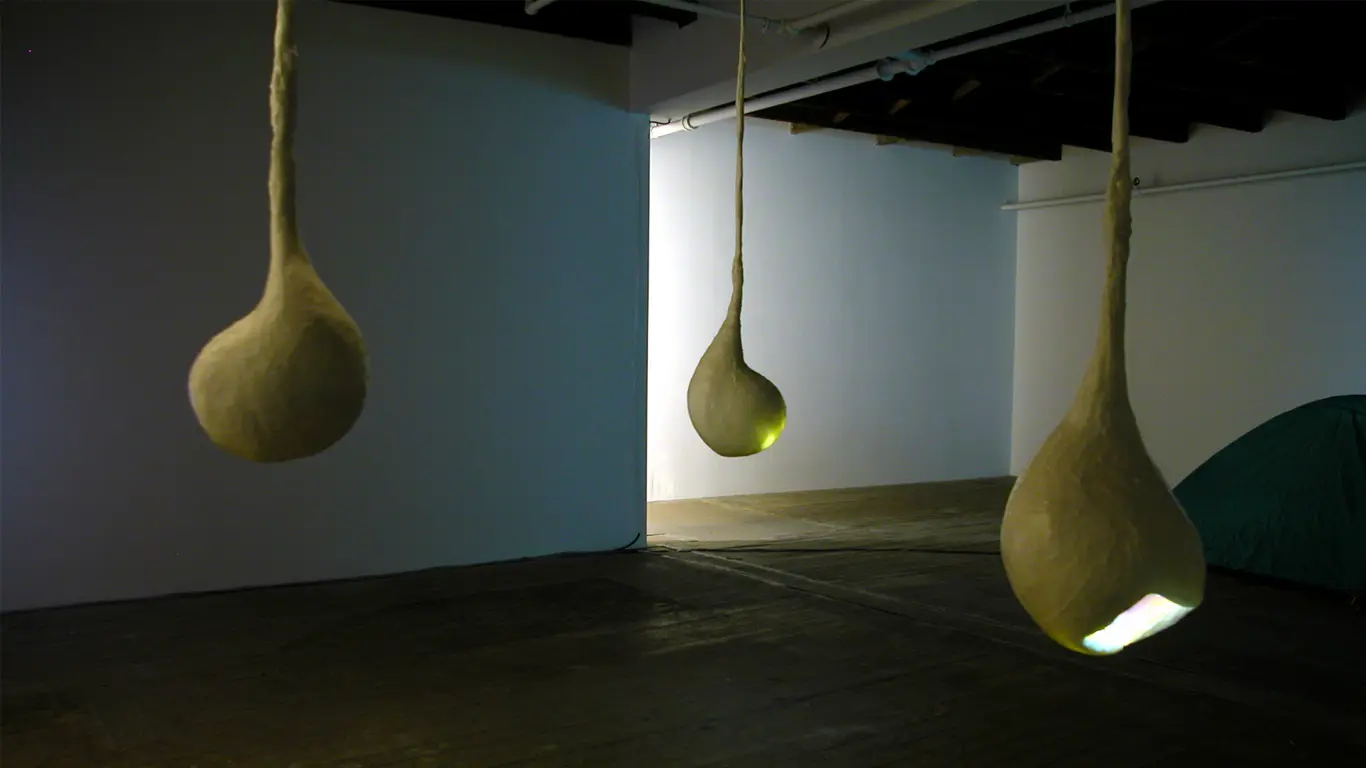
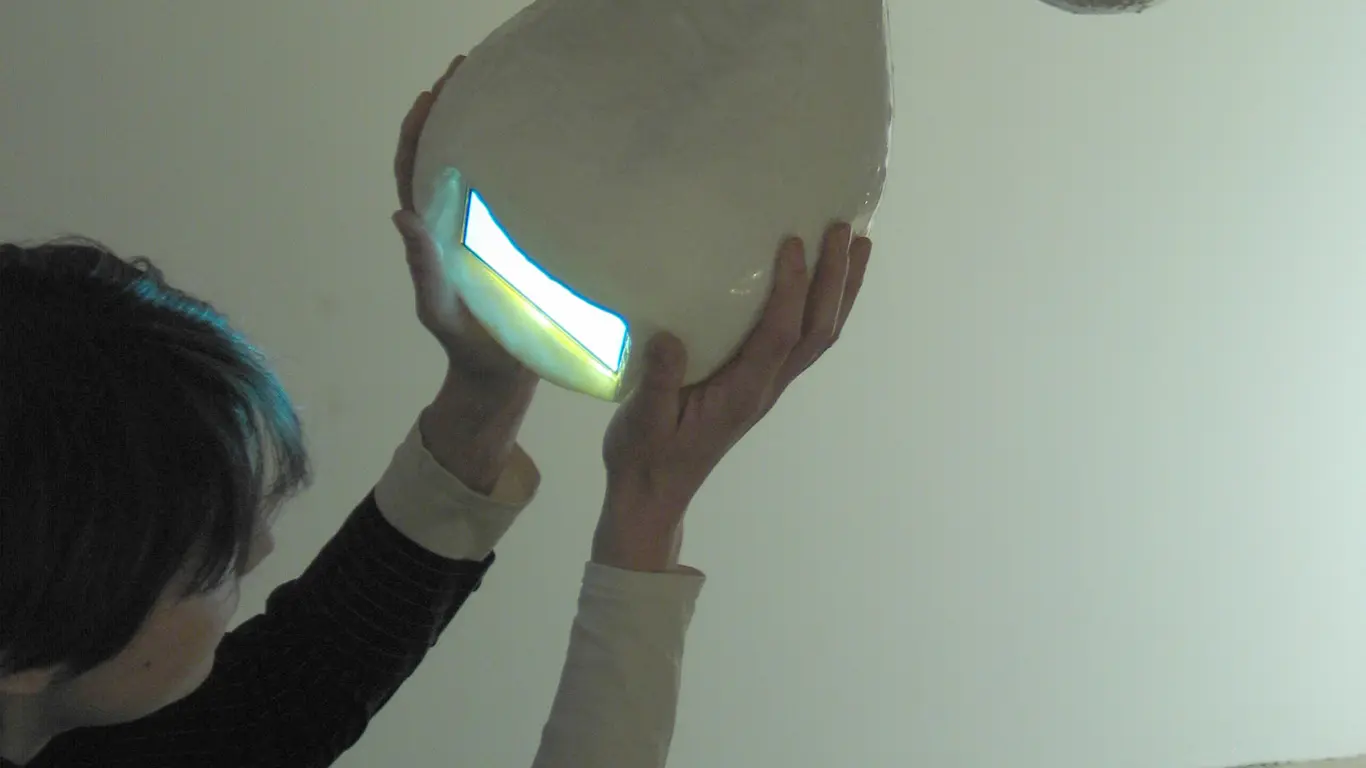
Misant sur une expérience tactile et un rapport physique avec le participant, Saisissement de Clara Bonnes engage les visiteurs à manipuler des objets aux formes arrondies qui permettent d’explorer des vidéos interactives. Disposés dans des plates-formes creuses prenant place sur des socles bas, ces objets sont conçus pour être aisément soulevés et tenus dans les mains. Ils laissent voir de petits écrans à cristaux liquides qui ne livrent leur contenu qu’une fois l’objet pris en main, pris avec soi.
De la dimension d’un petit ballon et dotés d’une forme vaguement anatomique – pouvant rappeler une tête, un ventre ou même un très jeune enfant -, ces éléments encouragent la saisie. La texture un peu caoutchouteuse du silicone qui les recouvre peut, quant à elle, fait penser à une peau, adhérant aux mains, retenant la prise et prolongeant l’activité du toucher. Faits de matière spongieuse à l’intérieur, les objets s’écrasent un peu sous la pression, comme le ferait un ballon ou une partie charnue du corps. D’un blanc translucide et affichant un fini lisse, ils ont toutefois un caractère artificiel et étrange qui conteste leur affinité directe avec le corps humain.
Le participant a donc affaire à des objets un peu anthropomorphiques mais aussi clairement artificiels qui ne cachent pas leur association au monde fabriqué. S’il est vrai que l’allusion au corps peut prédisposer à un certain rapprochement, elle peut aussi le contrarier. Le toucher suppose une intimité qui ne peut se réaliser qu’à certaines conditions variant selon les individus et les conventions sociales. C’est pourquoi l’apparence artificielle de ces objets joue en leur faveur en confirmant leur caractère élaboré, construit. Cette duelle suscite l’intérêt en même temps qu’elle provoque un certain malaise, une attente irrésolue.
Lorsque le visiteur prend un des trois objets, qu’il s’assoit pour le contempler à sa guise, il considère une image fixe qui apparaît dans l’écran. En appuyant sur l’objet muni de capteurs sensibles à divers endroits, il parvient à déclencher la vidéo et à animer l’image. Le plan fixe se met alors à bouger et son point de vue change. Le visiteur se voit transporté d’un endroit à un autre, ailleurs, toujours plus loin. Plus il presse l’objet, plus le déplacement s’accélère, l’entraînant dans un travelling avant. En faisant varier la pression qu’il exerce sur l’objet, il avance lentement ou rapidement, s’arrête ou recule, selon son désir de découvrir ce qui se trouve au bout du parcours.
Avec cette exploration interactive, Saisissement joue sur la curiosité, la volonté de s’engager dans une trajectoire. En visitant cette image, le participant part à la recherche, à l’aventure, sans trop savoir ce qui l’attend, le cheminement qui lui est proposé alimentant continuellement son intérêt sans le combler totalement. Sa quête exige une détermination constante s’il souhaite voir la vidéo jusqu’à son dénouement. En appuyant sur l’objet, il en exprime le contenu, d’une manière qui rappelle l’activité de presser une orange pour en extraire le jus. Or ce contenu ne lui est dévoilé qu’après un effort soutenu, une manifestation physique et tactile de son désir d’explorer et de trouver.
Chaque itinéraire le mène vers l’observation d’un individu occupé à une activité individuelle dans un lieu public (bibliothèque, motel, centre sportif) qui varie selon les trois objets interactifs mis à sa disposition. Il trouve donc une personne en fin de parcours, mais toute rencontre véritable s’avère impossible. Le spectateur devient plutôt témoin d’un geste, d’une attitude corporelle, de l’engagement d’un autre individu dans une occupation qui ne concerne que lui-même. Après avoir circulé dans un lieu public et anonyme comme s’il avait parcouru une image sans identité, le spectateur se retrouve devant une sorte de portrait vivant.
Accessible – il est visible, physiquement présent dans l’image -, mais non disponible – il est ailleurs, son monde intérieur est captif – , l’individu demeure insaisissable au bout du compte. C’est alors que le spectateur peut constater l’analogie pouvant être établie avec sa propre situation, absorbé qu’il est dans une activité individuelle dans un lieu public tout comme cet individu qu’il a observé. Par une sorte de mise en abîme, de similitude décalée, il est ainsi ramené à lui-même, à son propre comportement, tout employé qu’il est à saisir l’autre. L’installation invite ainsi à considérer cette situation paradoxale dans laquelle se trouve l’individu lorsque son univers intime est sollicité dans un contexte social.
En définitive, l’œuvre mise justement sur les références multiples de la notion de saisie : toucher, prendre, comprendre, être pris, éprouver. Le fait de toucher et de prendre avec soi physiquement coïncide avec un engagement mental et émotif, une intériorisation sans qu’il soit possible de déterminer avec certitude l’étendue de ce déplacement intérieur. En mettant à l’épreuve cette volonté de saisir l’extérieur des choses et des êtres pour accéder à leur monde intérieur, Saisissement nous fait prendre conscience de cette dualité et du caractère insaisissable de l’univers intime.
Sylvie Parent
Andrée Duchaine
Andrée Duchaine œuvre dans le milieu des arts visuels depuis 1973. En 1984, elle organise les premières rencontres vidéo internationales de Montréal avec le festival Vidéo 84. Elle s’implique également à titre de commissaire dans plusieurs expositions d’art-vidéo en Europe, aux États-Unis et au Canada. En 1985, elle s’installe à Paris et poursuit ses activités au niveau de la diffusion de courts-métrages auprès des chaînes de télévision à travers le monde, et crée sa compagnie de distribution de films.
Andrée Duchaine a travaillé à titre de contractuelle d’enseignement à l’Université du Québec à Montréal, en multimédia interactif. Elle a aussi enseigné à l’Université Paris VIII et à l’Université d’Ottawa. Elle a publié dans de nombreuses publications dont Parachute et la revue Espace. En février 2001 elle fonde Le Groupe Molior.
Sylvie Parent
Sylvie Parent est commissaire indépendante et critique d’art. Elle est impliquée dans le milieu des arts visuels et numériques depuis plus de 30 ans, aussi bien au Québec qu’à l’étranger. Ses expositions ont été présentées au Canada, aux États-Unis, en Italie, au Brésil, en Chine et à Taiwan.
De 2009 à 2014, elle a assuré la direction artistique de Molior, un organisme de diffusion d’expositions sur la scène internationale. Dans le domaine de l’édition, Sylvie Parent a agi comme rédactrice de magazines tels que HorizonZéro (2003-2005) et le Magazine du CIAC (1997-2000), et a contribué à plusieurs revues spécialisées (Parachute, Ciel variable, Espace art actuel, etc.).
Elle est également l’auteure de nombreux essais pour des catalogues d’exposition. Sylvie Parent est récipiendaire du prix Joan-Lowndes (2017) attribué par le Conseil des arts du Canada à un critique ou conservateur d’art indépendant en reconnaissance de la qualité exceptionnelle de son travail.
Artistes et œuvres
Clara Bonnes
Saisissement
2006
Installation vidéo interactive
Description de l'oeuvre
Saisissement est une installation vidéo interactive en temps réel qui comporte trois modules de silicone suspendus au plafond. Chaque module est composé d’un écran crystaux liquides (« LCD ») de 6 pouces et de différents senseurs de flexion, le tout inséré dans une forme ovoïde en mousse expansive flexible recouverte de silicone. La texture des objets s’approche de celle de prothèses mammaires. Les objets sont connectés à des ordinateurs par des manettes de jeu détournées, et contrôlent des patchs réalisés dans Max/MSP/Jitter. La programmation diffère subtilement d’un objet à l’autre car il s’agit de trois portraits différents : chaque objet a ainsi une personnalité différente en lien avec le sujet représenté, des réactions différentes aux manipulations du public. Le tournage du contenu vidéo et photo présenté a eu lieu dans trois domiciles distincts, et mettent en scène trois différents sujets représentés dans leur espace domestique.
Le public est donc invité à parcourir l’espace privé des trois sujets, et à faire l’expérience intime de chaque objet vidéo afin d’en découvrir les subtiles réactions.
Chaque module fonctionne sur la même base de programmation qui permet de ralentir ou d’accélérer le rythme de lecture de l’image. Cependant, chacun réagit différemment lorsque le spectateur le presse de façon plus intense. Le module Alexandra (présenté sur la documentation vidéo) permet de faire progressivement apparaître des images fixes, des gros plans en transparence. Ce portrait a pour objectif de faire se fondre le sujet avec son environnement immédiat, afin qu’ils soient indissociables l’un de l’autre, comme relevant d’une même sensualité. Le module Hermès permet quant à lui de faire apparaître de rapides successions d’images fixes (« snapshots ») de scènes intimes. Ce portrait a pour objectif de faire ressentir le caractère intense et spontané du sujet, teinté d’une touche d’exhibitionnisme. Enfin, le module Pascale permet de changer de séquence en pleine lecture. Ce dernier vise à faire ressortir les caractéristiques multiples de ce sujet et de son environnement : successivement espace d’habitation, de travail et d’exposition, l’unité de cet espace séquencé est rendue grâce aux sauts dans le temps permis par la manipulation. Le passage d’un plan à un autre est synchrone avec le déplacement dans l’espace. Ce sont donc les temporalités différentes qui sautent de l’une à l’autre.
Biographie
Après une licence en esthétique et sciences de l’art à la Sorbonne à Paris, Clara Bonnes a complété une maîtrise en arts visuels et médiatiques à l’UQAM. Sa recherche porte sur la façon dont différents portraits peuvent se dévoiler à travers la perception de l’espace, tantôt public, tantôt intime. Ses installations vidéo ont été présentées au Musée Régional de Rimouski, à la Galerie Art Mûr à Montréal, à L’Écart, lieu d’art actuel à Rouyn Noranda, à l’Agora / Festif, à la galerie VAV-Concordia et au CDEx-UQAM à Montréal, au Centre régional d’art contemporain de Soisson en France, à la galerie Michel Journiac à Paris. Elle s’intéresse aussi aux brèches qu’il est possible de créer dans les espaces publics. Cet intérêt l’a conduite à organiser différents événements de projections vidéo nocturnes dans l’espace urbain, lors entre autres des événements Itinéraire Bis et Nuits Blanches au CDEX, à Montréal. Membre active du Vidéographe et du conseil d’administration de Dare-Dare, elle s’est aussi investie dans l’organisation des évènements de diffusion vidéo EICV 2004 et EICV 2005 ainsi que Itinéraire Bis 2005.
François Quévillon
Magnitudes
2006
Installation vidéo interactive
Description de l'oeuvre
Cette installation interactive de François Quévillon s’inscrit dans la suite de son travail artistique qui explore la force évocatrice des phénomènes naturels. Les spectateurs sont ici immergés dans un environnement sonore ambiophonique et mis en relation avec une surface instable où s’opère un transfert d’énergie entre le public et l’oeuvre.
Magnitudes mise sur deux interfaces de reconnaissance vidéo qui alimentent un processus interactif permettant une expérience individuelle ou collective. À l’intérieur de l’oeuvre la polysensorialité est largement explorée; en plus de la vue et de l’ouïe du participant, la tactilité occupe une place importante grâce à un « écran-matière » interactif. Le rapport de proximité avec le dispositif sollicite le toucher du participant en s’axant sur les positions et les mouvements de ses mains à l’intérieur d’une expérience qui intègre des sensations haptiques et une rétroaction physique qui affecte le corps globalement. La dimension sonore est omniprésente, à l’environnement ambiophonique qui introduit le spectateur à l’oeuvre s’ajoutent deux compositions sonores qui résultent de l’interaction. L’installation explore le rapport entre les espaces virtuels et physiques en permettant au spectateur de les altérer.
Magnitudes prend la forme d’un object sculptural de 4 par 4 pieds de surface et de 2 pieds et 9 pouces de haut. La surface flexibe du dispositif, qui sert de plateau et d’écran interactif, est recouverte de particules blanches de dimensions variables qui donnent une matérialité à la fois aux images projetées et à la trame sonore interactive. Les gestes des participants sur cette surface qui suggère une matière glaciale sont retracés par des lignes accidentées éphémères, similaires à des fissures, accompagnées de sons de craquements. Cet « écran-matière » vibre selon l’activité détectée dans le périmètre immédiat de l’œuvre et à sa surface; la vibration est dûe à un son de vrombrissement qui s’accentue progressivement au cours de l’interaction et qui s’atténue en période d’inactivité. Une expérience collective de l’oeuvre vient lier les actions de l’ensemble des participants selon leur degré d’implication par la création de lignes tracées entre eux.
Biographie