SYNTHETIC TIMES - Media Art China 2008
National Art Museum of China (NAMOC), Beijing
Du 10 juin au 3 juillet 2008
Le Groupe Molior est invité à participer à SYNTHETIC TIMES – Media Art China 2008, du 10 juin au 3 juillet 2008, l’un des événements culturels majeurs associés à la tenue des Jeux Olympiques de Beijing. Présentée en plein coeur de la capitale au National Art Museum of China (NAMOC), seul musée d’art national dédié aux arts modernes et contemporains, cette exposition accueillait quarante-quatre oeuvres néomédiatiques réalisées par des artistes en provenance d’une trentaine de pays.
Le Groupe Molior y présentait trois oeuvres majeures créées par des artistes canadiens de renommée internationale : Luc Courchesne, David Rokeby et Rafael Lozano-Hemmer.
SYNTHETIC TIMES – Media Art China 2008, un événement artistique sans précédent dans l’histoire culturelle de la Chine contemporaine, dédié aux oeuvre-phares et actuelles les plus innovatrices, est sous la responsabilité de M. Zhang Ga, directeur artistique et commissaire.
Zhang Ga
Zhang Ga est un commissaire, artiste et professeur en arts médiatiques. Il a exposé internationalement, notamment au Centre Ars Electronica (Autriche), au Festival d’Art d’Adélaïde (Australie), au festival DEAF (Dutch Electronic Art Festival, Pays-Bas) au Whitney Museum of American Art (États-Unis), au Musée d’Art de Singapour (Singapour) et au Centre d’art Nabi (Séoul, Corée du Sud).
Il a organisé des conférences et des salons en arts numériques, et couramment il écrit, enseigne et intervient en qualité de critique sur les pratiques en arts médiatiques. Il a également été membre de jury pour des demandes de bourses en arts médiatiques.
Il est le directeur artistique et commissaire de SYNTHETIC TIMES – Media Art China 2008, un projet culturel relié aux Jeux Olympiques de Beijing et présenté au National Art Museum of China durant ces Jeux de 2008. Il fut aussi le directeur artistique et commissaire de Millennium Dialogue: Beijing International New Media Arts Exhibition and Symposium en 2004, 2005 et 2006.
Ses précédents mandats de commissaire incluent les suivants : Code:Blue, 3rd Beijing International New Media Art Exhibition (au Millennium Museum de Beijing, Chine), l’European Media Art Festival de 2006 (comme commissaire invité, à Osnabrück, Allemagne), Container Culture – ISEA2006 / ZeroOne, a Global Festival of Art On the Edge (San José, États-Unis), New Directions from China (galerie Plug-in à Bâle, Suisse), The Passage of Mirage — Illusory Virtual Objects (Chelsea Art Museum à New York, États-Unis), Towards A Recombinant Reality (Alternative Museum à New York, États-Unis). Avant de rejoindre l’Institut de Technologie de New York en 2005, il a enseigné durant de nombreuses années dans le cadre du programme du MFA Design and Technology à la Parsons School of Design.
Zhang Ga a étudié à l’Université des Arts de Berlin (UDK, Allemagne) et détient un Master of Fine Arts (MFA) de la Parsons School of Design de New York. Il est aussi Professeur invité à l’Académie d’Art et de Design de l’Université de Tsinghua à Beijing.
Andrée Duchaine
Andrée Duchaine œuvre dans le milieu des arts visuels depuis 1973. En 1984, elle organise les premières rencontres vidéo internationales de Montréal avec le festival Vidéo 84. Elle s’implique également à titre de commissaire dans plusieurs expositions d’art-vidéo en Europe, aux États-Unis et au Canada. En 1985, elle s’installe à Paris et poursuit ses activités au niveau de la diffusion de courts-métrages auprès des chaînes de télévision à travers le monde, et crée sa compagnie de distribution de films.
Andrée Duchaine a travaillé à titre de contractuelle d’enseignement à l’Université du Québec à Montréal, en multimédia interactif. Elle a aussi enseigné à l’Université Paris VIII et à l’Université d’Ottawa. Elle a publié dans de nombreuses publications dont Parachute et la revue Espace. En février 2001 elle fonde Le Groupe Molior.
Artistes et œuvres
David Rokeby
Taken
2002
Installation interactive
Description de l'oeuvre
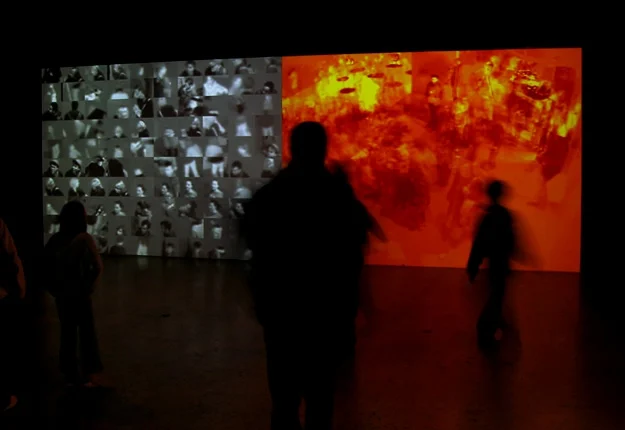
Taken est une installation de surveillance qui donne la possibilité d’une double lecture de l’activité se déroulant dans la galerie. Deux projections d’envergures apparaissent sur un des murs se trouvant dans un des grands espaces de la galerie. On voit sur la projection de gauche des images des visiteurs, filmées depuis le sol et les murs et projetées en boucle à un intervalle de vingt secondes. Ainsi, à partir du moment où l’ordinateur est en marche, les actions de tous les visiteurs de la galerie se retrouvent rassemblées sur l’écran de la projection, où elles se répètent à tous les vingt secondes. Le flot des images crée une sorte de chaos agité d’actions pouvant être perçu à la fois comme un portrait statistique de l’activité se déroulant dans la galerie (Où la majorité des visiteurs se tiennent-ils pour observer l’œuvre ? Se déplacent-ils dans l’espace ?) ainsi que comme le registre de chacune des actions posées par chacun des visiteurs. L’image projetée est d’une forte densité sociale, extrêmement stratifiée et chaotique. Sur la projection de droite apparaît, plus léger, le catalogue des visiteurs, qu’on suit de façon individuelle dans leur visite de la galerie. Le zoom se fait sur leur tête, et leur sont attribués des qualificatifs du type « sans méfiance », « complice » ou « affamé ». Ces images de tête sont intégrées à une collection comprenant les images de la tête des 200 derniers visiteurs, dont une centaine, et à l’occasion la totalité, sont projetées successivement au ralenti. Ce côté de l’installation est analytique, très ordonné et plutôt menaçant.
Biographie
Vit et travaille à Toronto
David Rokeby crée des installations interactives réagissant à la présence du spectateur ou explorant le potentiel de la base de données. Ses œuvres comportent aussi des interfaces permettant de capter et de transformer les mouvements des individus en sons ou en images.
Il expose régulièrement au Canada, aux États-Unis, en Europe et en Asie, notamment au Beall Center for Art + Technology (Irvine, Californie) en 2015, au Fresnoy – Studio national des arts contemporains (Tourcoing, France) en 2012, et au Whitney Museum of American Art (New York). Il a participé à des évènements internationaux, dont Electrohype 2010 (Ystad, Suède) et le Mois de la photo à Montréal (2009), Transmediale Festival (Berlin, Allemagne) et la Biennale de São Paulo en 2007. Molior a présenté son travail lors de Transitions / Transiciones, au Centro Cultural de la Pontificia Universidad Católica del Perú (PUCP) à Lima en 2007, et lors de SYNTHETIC TIMES – Media Art China 2008 au National Art Museum of China (NAMOC), Beijing.
En 1988, il obtient le Prix Petro-Canada en arts médiatiques. Le Ars Electronica Award of Distinction for Interactive Art (Autriche) lui est remis en 1991, en 1997 (conjointement avec Paul Garrin) et en 2002, année où il reçoit également le Prix du Gouverneur général en arts médiatiques.
Le Musée des beaux-arts de Montréal, le Musée des beaux-arts du Canada, la fondation Daniel Langlois et le Agnes Etherington Art Centre possèdent de ses œuvres. David Rokeby a également réalisé plusieurs œuvres d’art public.

Luc Courchesne
Where are You?
Description de l'oeuvre
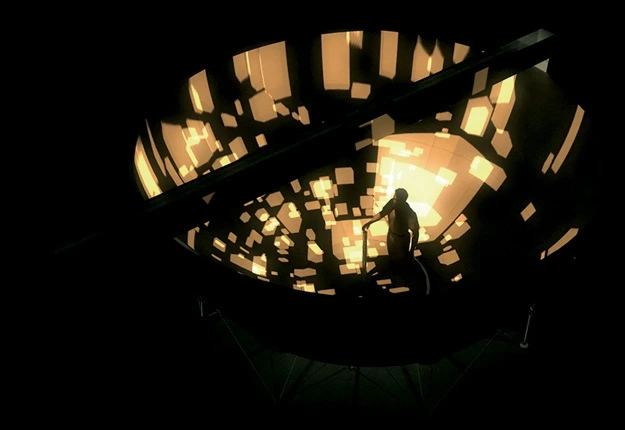
Where are you? (T’es où ?) invite les visiteurs à vivre l’expérience d’un univers 3D immersif à plusieurs échelles au sein duquel ils se déplacent à l’aide d’un pointeur omnidirectionnel.
L’échelle 0 se présente sous la forme d’une trame 3D navigable ; elle sert d’espace de calibration à la fois pour le système de projection et pour le visiteur qui s’y familiarise avec l’expérience immersive et les contrôles à sa disposition. Le passage à l’échelle +1 fait apparaître des regroupements d’éléments visuels et sonores organisés comme une archive. Chacun des éléments de cette archive fait office de micro-portail ; ils sont les jalons d’une trame narrative qui se révèle selon le parcours et l’intérêt des visiteurs. Au passage à l’échelle +2, les éléments de ces archives deviennent les particules de clusters dont la composition générale rappelle les vues impressionnistes du monde à la fin du 19e siècle et les premières formes de l’abstraction. Le passage à l’échelle +3 révèle enfin un paysage de montagnes et de vallées évoquant l‘idée du sublime pittoresque de la fin du 18e siècle.
À toutes ces échelles, les visiteurs peuvent faire la rencontre d’autres promeneurs : certaines de ces rencontres se font en direct à travers les liens de téléprésence ; d’autres sont pré-enregistrées dans des fenêtres vidéo évoquant leurs portraits interactifs antérieurs ; ultimement c’est à un face-à-face avec lui-même que sera confronté le visiteur qui croisera le regard de son propre avatar au sein du monde artificiel qu’il arpente.
Crédits :
Concept, scénario, design, réalisation et production : Luc Courchesne
Conception logicielle, modélisation des contenus et intégration : Guillaume Langlois
Musique, design sonore et systèmes audio 3D : Luc Martinez
Design optique : D’nardo Colucci, The Elumenati ; Simon Thibault, Immervision
Collaboration au design des écrans et fabrication : Sébastien Bire, Sébastien Dallaire
Réalisé en collaboration avec l’Université de Montréal et la Société des arts technologiques [SAT]
Biographie
Luc Courchesne fait figure de pionnier dans le domaine des arts numériques. Il adopte rapidement les technologies informatiques afin de réaliser des portraits vidéo conversationnels. Il rend ensuite le paysage sous forme d’images « panoscopiques » permettant une immersion visuelle. Ses travaux récents consistent en des dispositifs expérienciels associant l’espace virtuel à un horizon d’interactions humaines, des installations immersives interactives, et des œuvres explorant l’expérience de télé-présence.
Son travail est montré régulièrement au Canada et à l’étranger et il a participé à plusieurs évènements majeurs. En 1997, il a reçu le grand prix de la première biennale du NTT InterCommunication Center de Tokyo et, en 1999, l’Award of Distinction dans la catégorie « Interactive Art » des Prix Ars Electronica à Linz, en Autriche. Molior a présenté son travail à eARTS BEYOND: Shanghai International Gallery Exhibition of Media Art en 2009 et à SYNTHETIC TIMES – Media Art China 2008, au National Art Museum of China (NAMOC) de Beijing.
Professeur honoraire de l’Université de Montréal, Luc Courchesne est aussi membre fondateur de la Société des arts technologiques, codirecteur du SAT | Métalab et membre de l’Académie royale des arts du Canada. Il est représenté par la galerie Pierre-François Ouellette art contemporain.
Ses œuvres comptent parmi des collections privées et celles de plusieurs institutions publiques, notamment le Musée des beaux-arts du Canada, qui possède une de ses installations interactives.
Rafael Lozano-Hemmer
Eye Contact : Shadowbox 1
Description de l'oeuvre
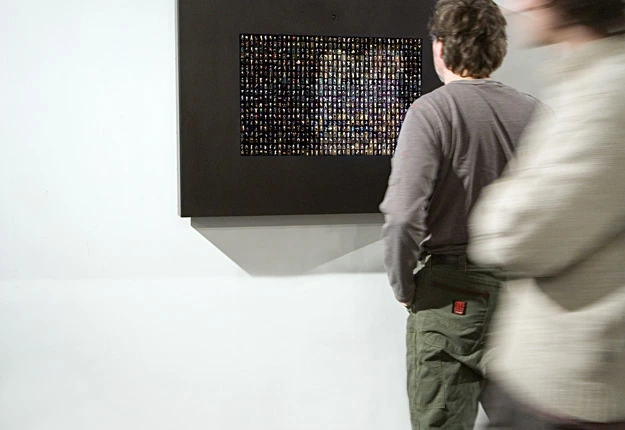
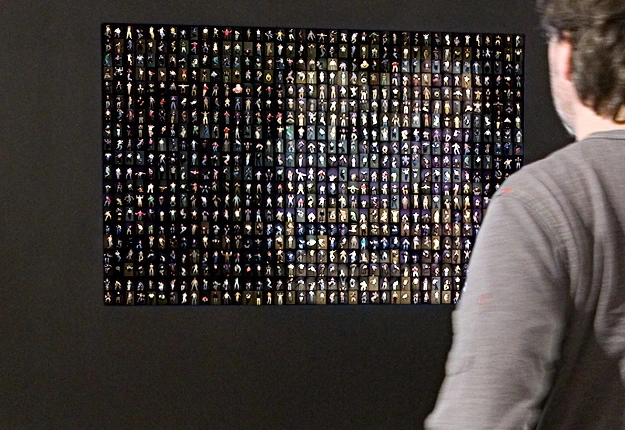
Eye Contact est la première de la série Shadow Box constituée d’écrans interactifs dotés de dispositifs de repérage. L’œuvre montre simultanément 800 vidéos de personnes allongées au sol, qui se reposent. Lorsqu’un visiteur est détecté par le dispositif, sa présence déclenche une réaction, soudainement les individus figurant dans les portraits miniatures se réveillent. Des centaines de personnes regardent directement le visiteur, ce qui a pour effet de créer une expérience troublante qui questionne les rôles de l’observateur et de l’observé.
Biographie
Détenteur en 1989 d’un baccalauréat en sciences (chimie physique, avec mineure en histoire de l’art) de l’université Concordia, à Montréal au Canada, Rafael Lozano-Hemmer a vite développé une pratique en arts électroniques. Bien connu pour ses installations interactives d’envergure occupant un espace public, il a participé depuis 1990 à nombre d’événements importants, récemment à la biennale d’Istanbul (2001) en Turquie, à la biennale de la Havane (2000) à Cuba, au festival Ars Electronica (2002) à Linz en Autriche. Parmi les nombreux prix ou distinctions accumulés au fil de sa carrière, mentionnons le Prix Ars Electronica Golden Nica en Autriche, attribué en 2000 pour Vectorial Elevation. Ses textes ont été publiés dans plusieurs magazines tels Leonardo (États-Unis), Kunstforum (Allemagne), Archis (Pays-Bas). Il a également donné des conférences et des ateliers, notamment au MediaLab du Massachusetts Institute of Technology, au Guggenheim Museum, au Netherlands Architecture Institute, à la Transmediale de Berlin et à l’Art Institute of Chicago.